Life in Gaza After the Ceasefire: A Mother's Story of Loss, Displacement and Survival
Six months after the Gaza ceasefire agreement, life has not returned to normal for families like Shurouq’s. A Save the Children staff member and mother, Shurouq, 31, has been displaced multiple times since the start of the war. She lost her husband in the early weeks of the conflict and is now raising her three-year-old daughter, Karmel*, amid destroyed homes, limited aid and ongoing insecurity. This is her story.
Media Contact: [email protected]
Written by Shurouq, a Save the Children staff member in Gaza | April 9, 2026
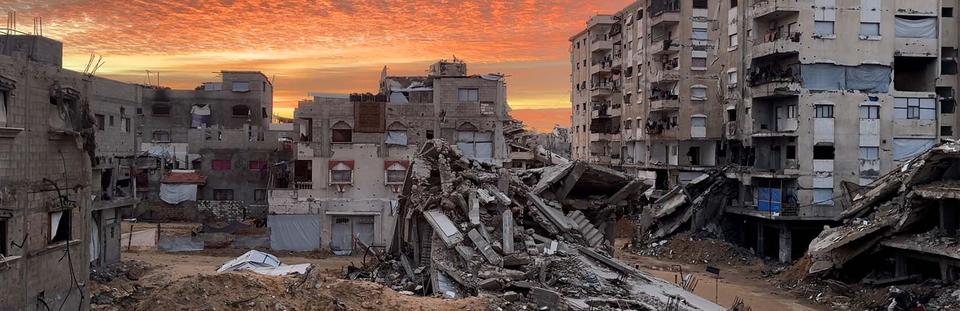
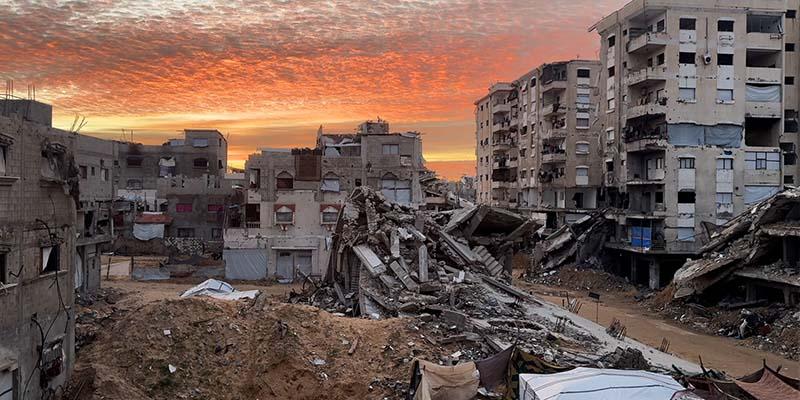
A view of destroyed buildings and rubble in Gaza, against a sunset.
Six months after the ceasefire agreement came into effect, we are still living in a grey city. Grey dominates everything, from the buildings to the streets to the dust on our faces. It even dominates our mood and futures.
You cannot move on or begin to heal while living in the same place where you experienced your worst nightmares – a place that hasn’t changed in months despite the bombs not falling as intensely, and agreements on a fast reconstruction. Every day on my way to work, I pass by my destroyed home.
Our home was a large rooftop apartment and each time I look at the building and see it destroyed I remember how much time and money my husband and I spent designing a modern home for a newly married couple.
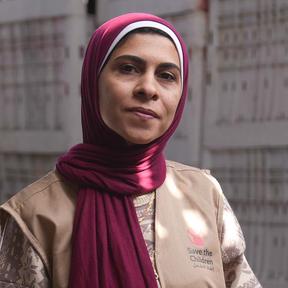
"We feel like we are living half in war and half in peace because nothing is happening on the ground to show us that there is a way to a brighter future."
- Shurouq, Save the Children staff member in Gaza
What breaks me the most is my daughter’s room. It was brand new and filled with pink, yellow, and purple toys and decorations. We designed it thinking that the room would grow with her through all the different stages of her life, but my daughter never spent a single night in that room.
How do I explain to a small child, who lost her father at 11 months old, that she once had a father, a home and her own bedroom painted bright pink, yellow and purple?
Six months into the ceasefire I don’t feel at home, even though I am in my homeland. I feel like a stranger who is displaced and with relatives. My daughter and I have lost our privacy.
We feel like we are living half in war and half in peace because nothing is happening on the ground to show us that there is away to a brighter future. We are still hearing bombs. Recently there was an attack just one street away from where I was with my daughter.
Yes, there are a few things that we are able to get now that we couldn’t get before, but nothing here is achieved without a struggle.
A few days ago, I managed to buy a refrigerator, but I still don’t have a source of electricity.
It was extremely difficult to find a refrigerator because prices were outrageous and because of the restrictions on electronic goods entering Gaza, but I felt like I had achieved a major life milestone just finding a refrigerator.
My daughter, who has lived through war most of her young life, thought it was a closet!
Throughout the war I have carried a constant feeling of guilt.
I feel guilty because I couldn’t protect my daughter from the sounds and shaking of bombs, hunger, fear or from life in a tent. My daughter wore boys’ clothes for most of her life because there were no girls’ clothes available during the war, but I felt a sense of victory when I managed to buy her clothes a month ago.
I felt like a child myself while shopping with her for clothes.
I also managed to fulfil her dream of owning a doll. No toys that I know of have entered Gaza since the ceasefire was announced, and searching for a toy was exhausting.
More food is now available in the market, but prices are still extremely high and availability is unstable. I'm struggling to find eggs. Every day I’m asking for eggs.
I miss things like having a hot shower directly from the tap. We must work so hard just to have these basic things. To give my daughter a shower I must heat up the water by using cooking gas or other alternatives, and we’re still struggling to get cooking gas.
Before the war we were living under a life- limiting and suffocating blockade for almost 18 years – the equivalent of an entire childhood. UN officials called it the largest open-air prison in the world. It was incredibly difficult to live through, but it seems like we took the most basic of things, like a hot shower, for granted. Because now it feels like there are struggles inside struggles. I constantly feel like I am unboxing struggles.
I often try to force myself to move forward and stop comparing life before the war to life after it, but I cannot.
There must be an increase in aid and goods entering Gaza, and principled reconstruction must begin as soon as possible. My appeal is to see more improvements here that show us there is truly a way towards a brighter future for me, for my daughter and for all of us.
Donate to Help Children in Gaza and Around the World
Save the Children is working in Gaza and around the world to support families caught up in crisis. Your donation today to the Global Action Fund helps children both in Gaza and around the world, every day and in times of crisis.