

America's Forgotten Promises to Afghanistan's Women and Children
By: Leslie Archambeault, Managing Director of Humanitarian Policy at Save the Children US.
A small child, maybe eight years old, limped toward one of Save the Children's earthquake response sites. He was all alone and leaning on a stick to cross the rocky terrain; his foot covered in a dirty neon cast. Drawn by the sounds of children playing, the bright red, yellow, and blue tents standing out amidst the sea of white around them, and the colorful balloons decorating the area—he hesitated.
"There are boys just your age inside," I heard a Save the Children colleague say, encouraging him to join the kids playing in our child-friendly space—a simple tent with tiny shoes lined up at the entrance. I watched as a smile lit up the boy's face and he hurried inside. The tent was filled with joyful children; howls of laughter could be heard from the distance.
Even months after visiting Kabul and the eastern provinces of Afghanistan, the echoes of these children's laughter have stuck with me vividly.
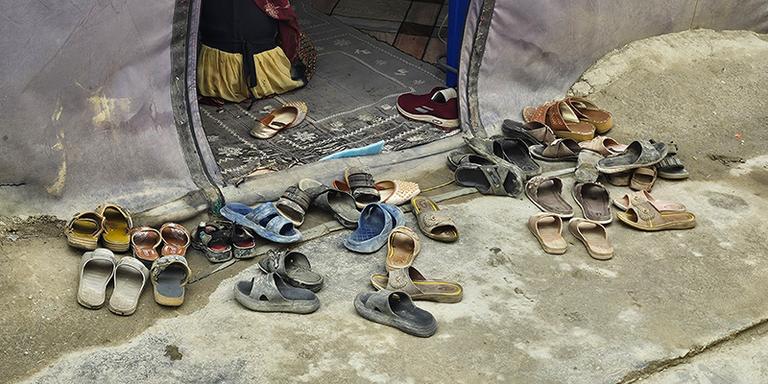
Children's shoes by the entrance to a Child Friendly Space
Children's shoes outside of a Child Friendly Space in Afghanistan. Credit: Leslie Archambeault
What Is Afghanistan Like? It's Full of Children
Children playing in child-friendly spaces that Save the Children has set up. Children in community-based education programs, sitting in rows on the ground, their backpacks and workbooks lined up. Children on the streets of small villages and larger cities, selling food to cars passing by. Small faces and even smaller hands, braving the traffic in an attempt to help their families—spending what should be a school day working… or simply waiting.
In Afghanistan, around 22 million people need humanitarian assistance, and over 11 million of them are children. That's nearly half of the country's population.
Seeing these kids firsthand, and witnessing families struggling to keep them fed, protected and warm, made it clear how their lives are blurred to abstraction in recent debates about U.S foreign aid cuts to countries like Afghanistan.
Humanity Owes Children the Best it Has to Give
My colleagues in Afghanistan—predominantly Afghans—show up every day, sometimes traveling for hours, to provide critical health and nutrition, education, and psychosocial support services to women and children across 21 provinces. I was awed by their commitment, creativity, and expertise, and very grateful for the time they took to show me their world, doing more with less everyday out of an abundance of compassion and a determination to save lives.
As an American, I was simultaneously severely disappointed and frustrated that my own country turned its back on the suffering of Afghan children and instead enacted policy choices that have compounded and exacerbated already extreme needs.
Last April, the U.S government terminated all humanitarian assistance to protect children and families in Afghanistan—despite bipartisan Congressional and Administration commitments to maintain support for lifesaving programs in crisis situations just like this one. Decades of repeated promises to protect Afghan women and children were reduced to empty words.
Zooming out, over 80% of all U.S. foreign assistance was terminated in 2025, but few countries lost all lifesaving investments in one stroke. The contrast is stark: while so many children’s lives could be saved through this funding, all U.S. foreign aid combined accounts for less than 1% of the federal budget—and lifesaving assistance to Afghanistan is just a small fraction.
Yet, even a small fraction of a lost fraction translates into a staggering human cost. The impacts are predictably devastating.
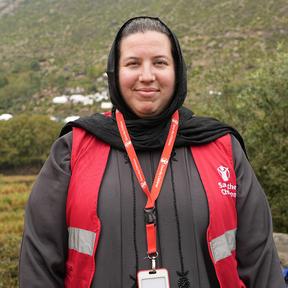
"Every child deserves a childhood—no matter who they are or where they live."
The Human Cost Behind American Policy
At least 422 health centers have closed across Afghanistan, as a direct result of the termination of U.S. funding last April, forcing people to turn to the few remaining facilities—now severely overburdened.
At one of Save the Children's women-only health clinics in Nangarhar province, I saw firsthand the overwhelming need. The relatively large space was packed. There, we provide a range of essential services: maternal and newborn health care with a full delivery room, nutrition screening and treatment, mental health and psychosocial support. The clinic also includes a pharmacy stocked with critical medicines prescribed by onsite doctors, and a play space for children while their mothers receive care.
Health services, including mobile and static facilities, are essential for children's survival. U.S humanitarian assistance once provided critical funding to keep these clinics operational. Now, their futures are in jeopardy, and more mothers and children are at risk.
Even before the closure of critical services, 24 mothers and 167 babies were predicted to die of preventable causes each day. Pregnancy and childbirth-related complications were responsible for 64% of deaths among adolescent girls aged 15 to 19, and 70% of deaths among women between 20 to 24 years old. These rates are all poised to increase dramatically given service disruptions.
Millions more women and children face acute malnutrition and lack access to clean water—essential for survival. Every acutely malnourished child today faces immediate health risks and also lifelong impacts, like a weakened immune system, physiological and psychosocial growth and development issues, to name a few.
The sudden termination of all U.S. lifesaving assistance to Afghanistan has deepened the humanitarian crisis, halting critical health services but also water, health and sanitation (WASH) infrastructure projects planned to improve water supply, and beyond. Clean water is not a luxury—it's life.
The America I believe in does not turn its back on suffering children or let them die of preventable causes. It protects children, whoever they are and wherever they may live.
Alleviating suffering, saving lives, protecting children are the right thing to do, the very metric by which we should measure our own humanity… And if humanity is not enough motivation, investing in children everywhere is an investment in a more peaceful and prosperous future for us all.
Afghan Children Need Action
Since returning to Washington, D.C., I have spoken to U.S. policymakers across the political spectrum. I've also seen over 100,000 fellow citizens step up to join Save the Children's political advocacy organization, Save the Children Action Network (SCAN), and send a letter to their representatives, pleading for action to protect Afghan children.
I have come to the resounding conclusion that Americans do indeed still care about children in Afghanistan, and that our values won’t let us ignore children suffering anywhere.
But caring is not enough. Afghan children need action. They need the U.S. government to restore lifesaving humanitarian assistance and to avoid putting in place new measures that would impede humanitarian work.
Resilience, fortitude and joy amidst the rubble can only go so far. Children cannot wait. Their lives are at risk now.
I urge the U.S. government to act quickly and to live up to the values that this country has held dear for generations. And I urge all of my fellow Americans to call or email their representatives to remind them that America does not turn its back on suffering children.
Every child deserves a childhood—no matter who they are or where they live. Afghanistan's children deserve the chance to survive, thrive, dream and play just as much as American children or any other nationality.
Join Save the Children's political advocacy arm, Save the Children Action Network (SCAN), and Tell Congress: Send lifesaving relief to Afghanistan now..